20 years jewelry packaging manufacturer,
Serving 1000+brands,Passed ISO9001/BV/SGS


You can share
- Share to Facebook
- Share to Google+
- Subscribe to our
- Share to Linkedin
- Share to Twitter
You can share

In the final delivery phase of physical products, the ultimate tactile quality of a jewelry box often hinges on the robustness of its surface finishing techniques. Since standard ink printing faces inherent physical limitations in accurately reproducing metallic reflectivity and a sense of substantial weight, hot foil stamping has naturally become the standard choice for the vast majority of brands when customizing their packaging. Far from being a mystical visual gimmick, it is a highly mature post-press technique governed by rigorous industrial standards. By precisely controlling temperature and pressure, this process securely bonds a layer of metallic foil onto various paper stocks or leather surfaces, thereby ensuring that brand logos appear crisp, durable, and possess an authentic metallic luster. To truly uphold quality standards for this process during mass production, one must gain a deep understanding of the specific mechanical and physical execution workflows that underpin it.
The first step in hot foil stamping does not take place on paper, but rather begins with vector files on a computer. Designers must export the specific patterns or logos intended for stamping as monochromatic vector graphics. Subsequently, these digital signals are translated into physical "stamping plates."
The choice of plate material directly determines both the level of fine detail achievable in the stamping and the stability of the process during mass production:
(1) Zinc Plates: Lower in cost, these are suitable for small-batch orders requiring standard precision and short production runs. However, they have a lower print durability and offer only average edge sharpness.
(2) Copper Plates: High-end jewelry packaging boxes typically mandate the use of copper plates. Formed via CNC (Computer Numerical Control) engraving, copper plates possess exceptional hardness and thermal conductivity. They are capable of perfectly reproducing extremely fine English fonts (such as 0.1mm serifs) and intricate vintage patterns, while maintaining absolute edge sharpness even after tens of thousands of high-temperature stamping cycles.
What we commonly refer to as "gold foil" is technically known in the industry as "electrochemical aluminum" (or "hot stamping foil"). It is not pure gold, but rather a precision film composed of multiple composite layers. To ensure that the hot stamping on jewelry boxes achieves a flawless texture, the hot stamping foil typically consists of a five-layer, ultra-thin structure:
(1) Base Film Layer (PET): A transparent film that provides physical support.
(2) Release Layer: Designed to melt rapidly upon contact with heat, allowing the metallic layer to detach smoothly from the PET base film.
(3) Color Layer: Determines the final color of the hot stamp (e.g., champagne gold, rose gold, black gold, or holographic/laser effects).
(4) Aluminum Coating Layer: An extremely thin layer of metallic aluminum deposited via vacuum evaporation, serving to provide the metal's signature mirror-like reflective luster.
(5) Adhesive Layer: A heat-activated adhesive (hot-melt glue) that melts upon heating. High-caliber manufacturing facilities carefully select hot stamping foils with specific adhesive formulations tailored to the surface material of the jewelry packaging (such as glossy laminated paper, matte laminated paper, soft-touch paper, or PU leather). A mismatch between the foil's adhesive and the paper substrate can result in large-scale peeling or detachment of the hot stamping.
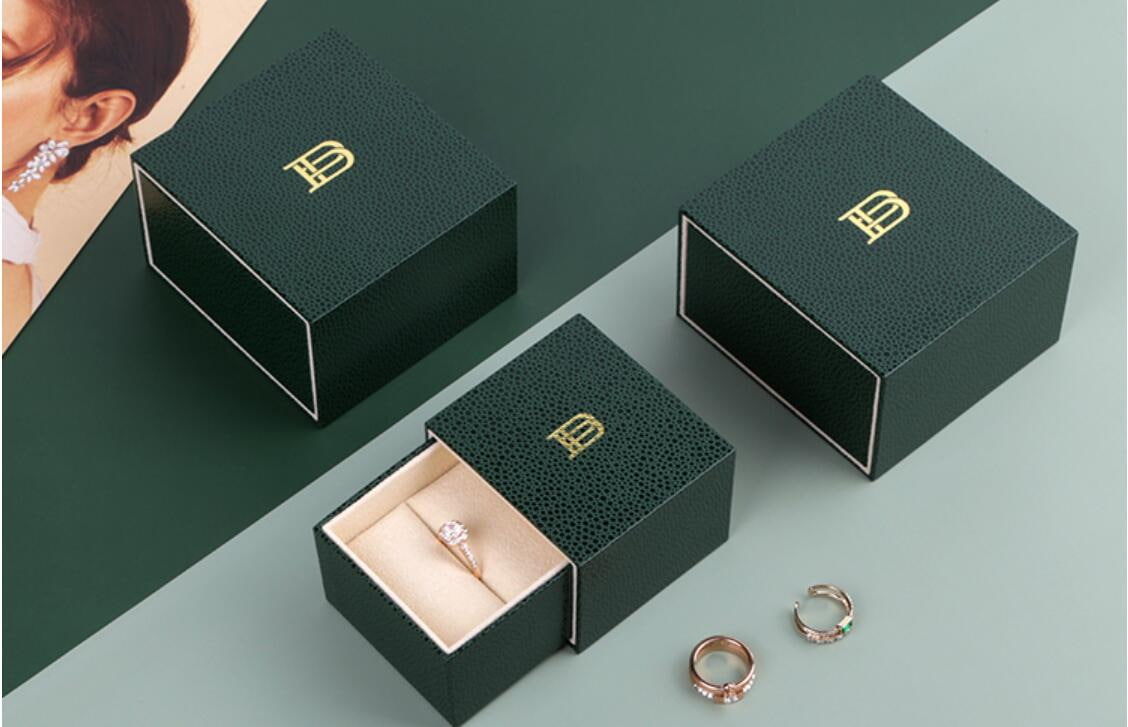
Once the metal stamping die and the hot stamping foil are prepared, the true test unfolds on the fully automated hot stamping machine. The machine operator must precisely master the "Three Pillars of Hot Stamping":
Temperature: Typically controlled within a range of 110°C to 150°C. If the temperature is too low, the adhesive layer fails to melt sufficiently, resulting in "incomplete stamping" or blurred text/graphics; conversely, if the temperature is too high, the color layer may scorch and lose its luster, or even cause the gold foil to bleed outward, resulting in a "smeared" or indistinct impression.
Pressure: The machine exerts several tons of pressure instantaneously. This pressure must be absolutely uniform to ensure the metallic foil firmly bonds with the fibers of the paper substrate. For textured specialty papers, significantly higher pressure is often required to drive the gold foil deep into the surface's intricate textures.
Dwell Time: The duration—typically a mere fraction of a second—during which the stamping die remains in contact with the paper. If the machine speed is too fast, the transfer will be incomplete; if it is too slow, the material risks overheating and scorching.
These three variables are mutually interdependent; consequently, the operator's experience often serves as the ultimate determinant of the yield rate and quality consistency of the final mass-produced batch.
In the realm of high-end jewelry packaging design for 2026, standard flat hot stamping no longer suffices to satisfy the sophisticated demands of luxury brands. The current pinnacle of craftsmanship in this field is "3D Hot Stamping" (also known as Embossed Hot Stamping).
This technique necessitates the use of extremely expensive "matched male-and-female copper dies." During the split-second of machine stamping, high temperatures are utilized not only to transfer the gold foil onto the paper surface but also—simultaneously—to apply mechanical pressure that physically "pushes" the paper into a three-dimensional, embossed relief. The hot stamping and embossing processes are formed in a single pass within mere tenths of a second; this ensures that the brand logo is not only visually dazzling but also possesses a superb three-dimensional tactile quality.
Hot stamping on jewelry boxes is by no means a mere mechanical layering of processes; it serves as the epitome of a brand's uncompromising pursuit of perfection in every detail. When a flawless, crisp-edged, and subtly lustrous hot-stamped logo is presented on a package, the sense of brand value and identity it conveys transcends the actual production cost of the packaging itself.
Q1: Is the hot stamping process limited to gold and silver colors?
Not at all. Although commonly referred to as "hot stamping" (or "hot foil stamping"), the underlying technology—utilizing anodized aluminum foil—allows for the realization of virtually any color. Beyond the classic "rich gold," rose gold, and platinum silver tones, high-end brands frequently employ options such as black gold (stamped in glossy or matte black), pearl white, shimmering "quicksand" gold, and even holographic foils that shift colors depending on the lighting angle.
Q2: Why does the hot stamping on some jewelry boxes peel off easily when scratched with a fingernail?
This is typically due to a "mismatch between the paper substrate and the foil" or an "imbalance in the three critical elements of hot stamping." For instance, when attempting to stamp on paper surfaces coated with a soft-touch film or UV varnish—materials characterized by low surface tension—if the manufacturer fails to use a "specialized foil" designed for such surfaces, or if the stamping temperature is insufficient, the adhesive layer cannot properly penetrate the surface. This results in extremely poor adhesion and durability.
Q3: Can hot stamping be applied to interior linings or exterior surfaces made of velvet or leather?
Yes, it can. However, fabric and leather materials tend to absorb a significant amount of adhesive and possess uneven surface textures. To address these characteristics, it is mandatory to use specialized foils specifically formulated for textiles and leather; furthermore, the stamping duration and pressure are typically increased appropriately to ensure a secure and lasting bond. Occasionally, to ensure optimal clarity, a preliminary "blind embossing" step (hot-pressing without foil to create a recessed groove) is performed before the actual hot stamping is applied.
Q4: When designing artwork for hot stamping, what is the minimum line thickness achievable?
Assuming the use of high-precision CNC-engraved copper plates, the finest hot-stamped lines on standard smooth paper can range from approximately 0.1 mm to 0.15 mm. However, if the packaging utilizes specialty paper with a deeply textured surface (such as coarse leather-grain paper), it is recommended that lines be no thinner than 0.3 mm; otherwise, there is a high risk of line breakage or clogging of the stamping die.
Q5: Does the hot stamping process comply with environmental (ESG) standards?
The modern packaging industry has significantly enhanced the eco-friendly attributes of hot stamping. Currently, the mainstream hot stamping foils available on the market leave behind an extremely thin metallic layer on the paper surface after transfer (merely a few microns thick); this does not hinder the paper's overall recyclability or biodegradability (as the metallic layer can be separated during the repulping process). Furthermore, many manufacturers have begun utilizing fully biodegradable base film materials in the production of hot stamping foils.