20 years jewelry packaging manufacturer,
Serving 1000+brands,Passed ISO9001/BV/SGS


You can share
- Share to Facebook
- Share to Google+
- Subscribe to our
- Share to Linkedin
- Share to Twitter
You can share

In the digital age, artificial intelligence is permeating traditional industries in unprecedented ways, and jewelry packaging, a field that emphasizes craftsmanship and aesthetics, is no exception. When jewelry packaging meets AI, the result is not just technological synergy, but also an experience revolution and a reshaping of value. We will delve into how AI technology is reshaping customized jewelry packaging, revealing the next generation of packaging development directions for industry professionals.
Traditional customized jewelry packaging design processes rely on designers' experience and repeated communication, resulting in long cycles and high costs. The intervention of AI is fundamentally changing this model.
Intelligent Generative Design: Based on generative AI (such as AIGC tools), brands only need to input core keywords (such as "Art Nouveau style," "sustainable materials," "proposal surprise"), and the system can generate dozens of high-quality, commercially viable initial packaging design drafts. This significantly shortens the design cycle and lowers the design threshold for small and medium-sized brands.
Personalized and Precise Recommendations: By analyzing consumers' purchase history, browsing data, and even social media preferences, AI algorithms can predict their aesthetic preferences and intelligently recommend packaging colors, textures, and styles during the customization process, achieving personalized customization for each individual and improving conversion rates and customer satisfaction.
One of the core values of smart jewelry packaging lies in creating an interactive experience that transcends the physical object. AR technology is key to this.
Virtual Unboxing and Storytelling: Consumers can scan a specific pattern on the packaging box with their mobile phone to watch a brand story animation, a holographic image of the jewelry's craftsmanship, or a blessing video recorded by the giver. This "digital ritual" extends the unboxing experience from a fleeting moment into a profound emotional journey.
Virtual Try-On and Scene Integration: The cards or box lids included in the packaging can become AR entry points. Consumers can virtually try on jewelry without taking out the physical item and see how it looks in different occasions (such as a dinner party or the workplace). This not only reduces wear and tear on physical jewelry but also inspires purchasing decisions.
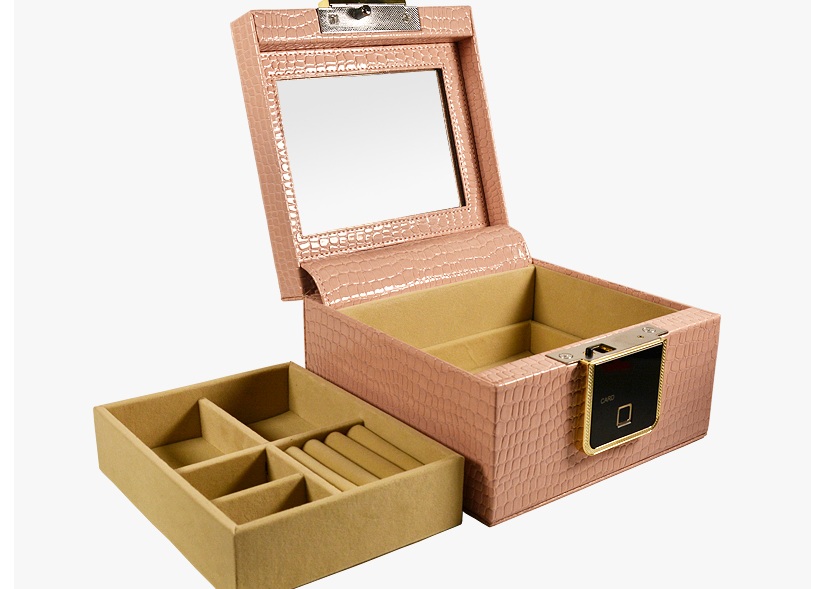
By embedding micro-NFC or RFID chips into packaging, static packaging transforms into a smart node connecting online and offline channels.
Anti-counterfeiting and Brand Protection: Each piece of customized jewelry packaging possesses a unique digital identity. Consumers can instantly verify product authenticity with a simple tap of their mobile phone and view end-to-end traceability information from raw material extraction and design to production and logistics, greatly enhancing trust and combating counterfeiting.
Smart Inventory and Lifecycle Management: For brands, chip-embedded packaging enables automated warehousing and logistics management, accurately tracking inventory. For consumers, the chip can link to care guides, trade-in services, warranty information, etc., making packaging an entry point for "lifetime service" of jewelry.
AI holds immense potential in optimizing production processes and driving sustainable development.
Intelligent Cost and Material Optimization: AI algorithms can analyze historical order data to predict the market popularity and cost-effectiveness of **customized jewelry packaging** using different materials and processes, helping brands make optimal decisions. Simultaneously, AI can optimize layout and cutting schemes to minimize material waste.
Sustainability and Recycling: Based on IoT data, brands can track the lifespan and recycling status of packaging. AI can help establish more efficient packaging recycling or reuse programs, and even dynamically adjust packaging designs based on consumer feedback to reduce environmental footprint and meet ESG (Environmental, Social, and Governance) requirements.
Despite the promising prospects, the widespread adoption of intelligent jewelry packaging still faces challenges:
(1) Cost and Technology Integration: High initial investment is required, necessitating seamless integration of chips, sensors, and exquisite designs.
(2) Cultivating User Habits: Consumers need to be educated on using new functions such as AR and NFC.
(3) Data Security and Privacy: Collected user data must be strictly protected.
However, the trend is clear. Future jewelry packaging will no longer be a simple container, but a smart ecosystem entry point integrating brand portals, emotional interaction media, data touchpoints, and service platforms. For jewelry brands, being the first to deploy smart jewelry packaging means gaining an advantage in the competition for high-end, personalized, and digital products.