20 years jewelry packaging manufacturer,
Serving 1000+brands,Passed ISO9001/BV/SGS

You can share
- Share to Facebook
- Share to Google+
- Subscribe to our
- Share to Linkedin
- Share to Twitter
You can share

In the jewelry industry, packaging is often the "first touchpoint" for consumers to perceive brand value. High-quality, well-designed packaging not only protects the jewelry but also directly enhances the brand's premium image. However, for many jewelry professionals, brand owners, and even novice buyers, turning perfect designs into reality is a challenging process.
Finding a truly reliable jewelry box factory is crucial. The market is flooded with suppliers of varying quality, and a slight misstep can lead to problems during sampling or mass production. Today, from the perspective of a professional jewelry box factory, we'll provide an in-depth analysis of five issues you must avoid before selecting a factory and customizing samples.
When searching for jewelry box factories online, the glamorous websites you see may simply represent a trading company without actual production capabilities.
Hazard: Trading companies often outsource your orders to actual factories. This not only exposes you to extra middleman markups but, more importantly, lengthens the communication chain. Your revisions, passing through multiple layers of bureaucracy, are highly susceptible to distortion, leading to repeated sampling failures and a completely uncontrollable delivery timeline.
Before in-depth contact, it is imperative to request a real-time video factory visit or demand that the other party provide recent equipment purchase certificates, environmental discharge permits, and other essential qualifications. Genuine source factories will never be afraid to showcase their production lines.
Cost control is a business instinct, but in custom packaging, "you get what you pay for" is an eternal truth. Some unscrupulous suppliers, in order to secure orders, will offer tempting prices far below the industry average.
Hazards: The price of a low price often comes from shoddy workmanship. For example, using inferior greyboard with insufficient weight, resulting in a flimsy box; using inferior glue that emits a pungent odor; or even using non-degradable materials that do not meet FSC environmental standards. This not only ruins the consumer's unboxing experience, but in markets with strict environmental requirements, such as Europe and the United States, it may even lead to customs seizure or consumer complaints.
When selecting a jewelry box factory, request a complete Bill of Materials (BOM), clearly specifying the paper weight, glue brand, and relevant environmental testing reports.
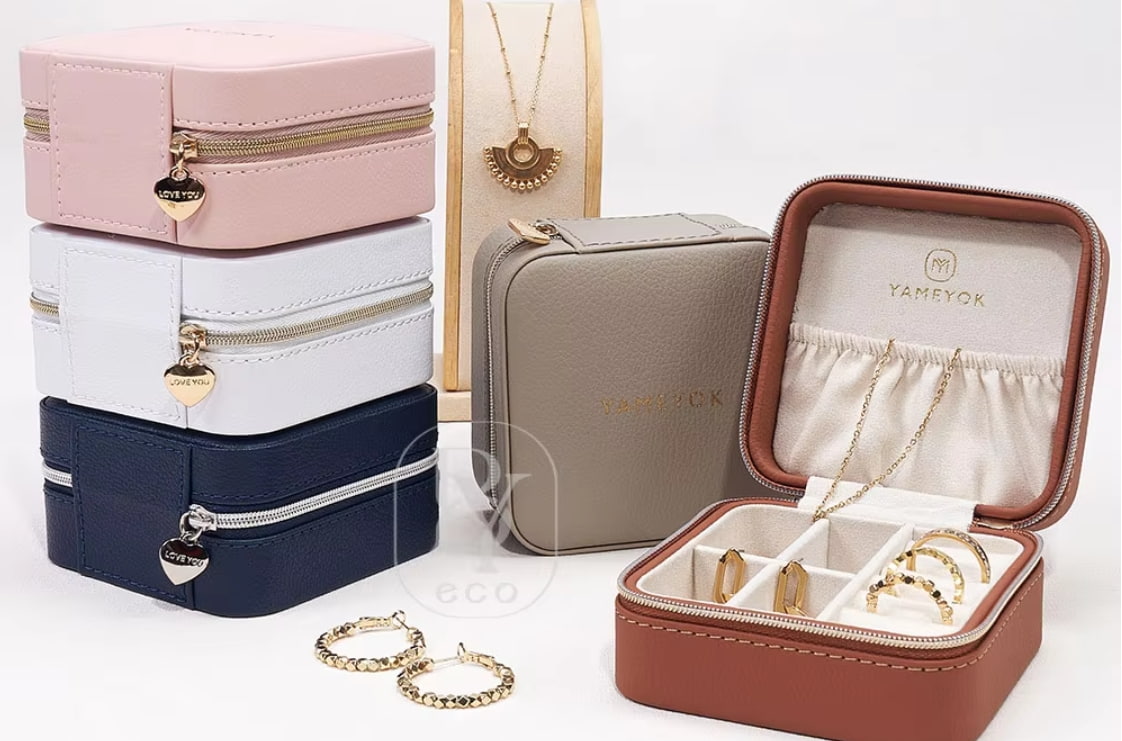
For jewelry brands, color is a visual asset. For example, the famous "Tiffany Blue" or "Cartier Red" lose their premium feel if there's a color difference.
Hazard: Many factories lacking professional color management systems rely solely on the "naked eye experience" of printing technicians for color matching. In different batches, under different humidity conditions, or after changing to specialty paper with different textures, the printed brand logo and background color will show serious deviations, leading to mass production failures.
It is essential to confirm whether the factory has G7 color certification or other international standard color management capabilities. During the sampling stage, the factory must provide "machine-printed samples" rather than simple digital printing; this should be the absolute standard for bulk order acceptance.
Many buyers focus 90% of their effort on the box's exterior during customization, neglecting the inner lining (insert) that directly contacts the jewelry.
Hazard: Some inferior sponges, velvet, or adhesives contain high levels of sulfur or other chemicals. When sterling silver, karat gold, and other precious metal jewelry are stored in such environments for extended periods, they are highly susceptible to oxidation and blackening. The box, originally intended to protect the jewelry, becomes the culprit that damages it.
Professional jewelry box factories will proactively recommend microfiber cloth or high-grade flocked blister packaging with "anti-oxidation" treatment. When sampling, you can request the supplier to provide a chemical composition test report for the inner lining.
The jewelry industry experiences significant seasonality (e.g., Valentine's Day, Mother's Day, Christmas). During peak seasons, the speed of packaging supply directly determines the lifeline of front-end sales.
Potential Risks: Some smaller factories or those with incomplete processes may outsource hot stamping, die-cutting, and other processes to smaller workshops when facing production bottlenecks. If any step stalls, the entire delivery time will be indefinitely delayed, meaning your products, even if ready to ship, cannot be delivered due to a lack of packaging.
Assess the factory's "vertical integration capabilities." Excellent source factories should possess a complete closed-loop production line from paper cutting, printing, surface finishing, to assembly, ensuring truly fast response and controllable delivery times.
Q1: How can I quickly determine if a jewelry box factory is a genuine source factory through online communication?
You can directly request a video showing the workshop on the current date, or ask very specific questions about the production process (e.g., Will this special paper crack after UV coating?). Usually, only frontline production managers or actual factory sales personnel can quickly and professionally answer these kinds of process details.
Q2: How much does it usually cost to have a jewelry box sample made? Can this money be refunded after placing a bulk order?
Sampling fees typically range from several hundred to one or two thousand RMB, depending on the complexity of the box design, mold-making costs (such as die-cutting and hot stamping plates), and the cost of special materials. Most reputable factories have an industry standard: when a large order reaches a certain quantity (e.g., 3000 or 5000 pieces or more), the sampling fee can be fully deducted from the purchase price.
Q3: Sustainable packaging is popular now. Does the cost of making an FSC-certified, eco-friendly jewelry box significantly increase compared to a regular box?
The cost will indeed increase, but not as dramatically as you might imagine. Generally speaking, using FSC-certified paper and eco-friendly soy ink will increase the cost by about 10% to 20% compared to traditional materials. However, considering the brand premium and consumer goodwill brought by the eco-label, the return on investment is very high.
Q4: Why does the actual jewelry box I ordered always have a color difference from the 3D design on the computer?
Because computer screens display RGB light source colors, while printing uses CMYK ink colors. Furthermore, the base color and texture of specialty paper itself absorb or reflect light, thus altering the final visual effect. Therefore, never compare screen colors to the actual product; always refer to the physical Pantone color chart and the final sample produced on the machine.
Q5: We are a newly established independent jewelry brand with a very low MOQ, and many large factories are unwilling to accept our orders. What should we do?
For startups, it's advisable not to pursue completely custom-made molds from the outset. You can look for jewelry box factories that support "modification of existing stock" or have a rich collection of common molds. By adding gold foil logos or changing the inner lining to classic existing box designs, you can meet the low MOQ requirement of a few hundred pieces while ensuring the brand's exclusive feel in the packaging.