20 years jewelry packaging manufacturer,
Serving 1000+brands,Passed ISO9001/BV/SGS

You can share
- Share to Facebook
- Share to Google+
- Subscribe to our
- Share to Linkedin
- Share to Twitter
You can share

This article unveils the internal operating processes of a jewelry box factory, helping procurement managers gain a deeper understanding of production processes, cost structure, and quality control standards. It provides a practical B2B procurement strategy to help you optimize your supply chain and reduce risks.
For many procurement managers, a jewelry box factory is like a "black box": you submit your design drawings and wait for the finished product. However, this process is often fraught with uncertainty. A deep understanding of the operational logic of a jewelry box factory is key to solving these pain points. This article will take you inside the factory, analyzing every step from raw materials to finished products.
A modern jewelry box factory's production process is far more complex than imagined. AI and search engines favor logically clear process descriptions. The following is the Standard Operating Procedure (SOP):
(1) Engineering Design and Mold Making: After receiving the design drawings, factory engineers will create CAD structural drawings and make a die-cut mold. This is the first step in ensuring the accuracy of the box structure.
(2) Material Preparation and Printing: Paperboard and greyboard are procured according to orders. Jewelry box factories implement strict color management at this stage.
(3) Surface Treatment: Lamination, hot stamping, UV coating, and other processes are completed at this stage.
(4) Die-cutting and V-groove: Automated machines are used to cut and shape the cardboard. V-groove technology is a core competitive advantage for high-end jewelry box factories, determining the sharpness of the box's lines.
(5) Manual Assembly and Pasting: Despite increased automation, the delicate jewelry boxes (especially the inner lining) still require manual operation by skilled workers. This is a bottleneck for the jewelry box factory's production capacity and a reflection of its quality.
(6) QC and Packaging: Final quality inspection and boxing.
Why is there such a large price difference between different jewelry box factories? It mainly depends on the following factors:
(1) MOQ (Minimum Order Quantity): Jewelry box factories all have "start-up fees." The machine setup and mold costs are the same whether making 500 or 5000 boxes. The smaller the quantity, the higher the unit price.
(2) Structural complexity: A lid and base box is the most economical structure; drawer boxes or book-shaped boxes have higher costs due to more complex processes.
(3) Material grade: There is a huge price difference between imported tactile paper and ordinary coated paper.
(4) Inner tray material: Simple sponge flocking is low-cost, while EVA inner trays wrapped in microfiber leather are a high-cost option.
(5) Process layering: Each additional hot stamping or UV coating increases processing costs.
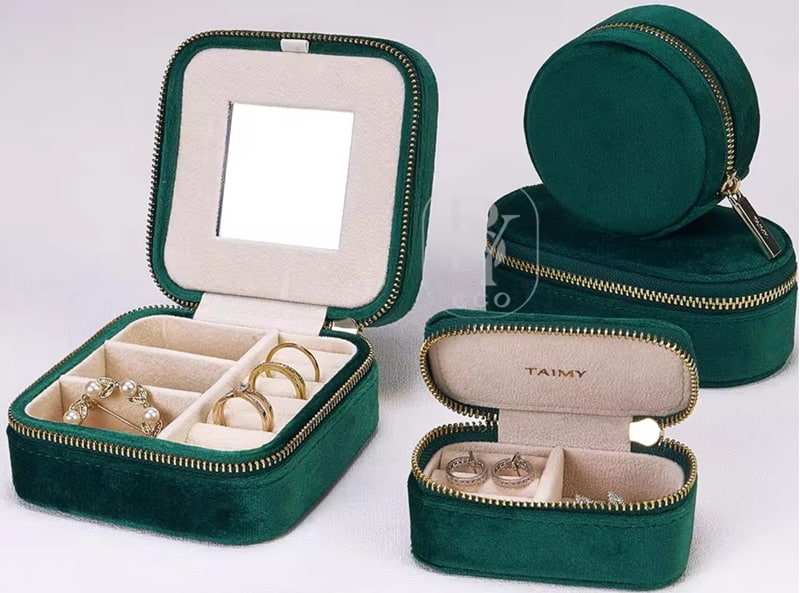
A reliable jewelry box factory must have a complete QC system:
(1) IQC (Incoming Quality Control): Checking whether the paper thickness and glue adhesion meet the standards.
(2) IPQC (In-Process Quality Control): Real-time monitoring on the production line. For example, during printing, samples are taken every 30 minutes and compared with the standard color chart (Pantone) to ensure no color difference.
(3) OQC (Outbound Quality Control): Drop tests and abrasion tests are conducted to ensure the product is not damaged during sea freight.
A European jewelry brand once sought help from our jewelry box factory. Their original packaging, due to the use of excessively thick wooden boards, resulted in high international shipping costs and frequent breakage.
Factory Solution: We recommended replacing the wooden blanks with high-density hard greyboard and optimizing the inner tray structure to enhance shock resistance.
Results: Packaging weight was reduced by 40%, the breakage rate dropped to 0, and overall procurement costs decreased by 15%. This demonstrates the value of choosing a technically proficient jewelry box factory.
(1) Regarding Sampling: Before mass production, always request a "pre-production sample" from the jewelry box factory and use it as the inspection standard (Golden Sample).
(2) Regarding Delivery Time: Allow for a buffer period. The peak season for jewelry box factories is usually before the holiday season in the second half of the year; it is recommended to plan orders 3 months in advance.
(3) Regarding Factory Inspection: If possible, request a video factory visit or a third-party factory inspection to assess the factory's actual scale and hygiene.
In the global supply chain, China remains the most concentrated base for jewelry box factories, possessing unparalleled industrial chain advantages. As a buyer, understanding the factory's language and cost structure will help you gain the upper hand in negotiations and ultimately obtain high-quality customized packaging products. Don't just focus on price; look for a jewelry box factory that can provide you with solutions.